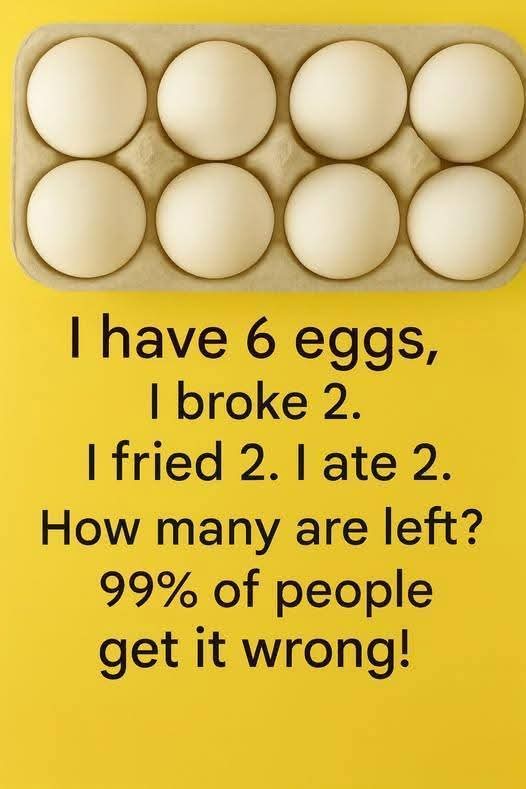
The 6-Egg Riddle: Why This Simple Math Problem Baffles Almost Everyone
Social media is famous for “simple” math riddles that claim 99% of people will fail. While that percentage is usually an exaggeration, the 6-egg riddle genuinely trips people up because it isn’t a test of your math skills—it’s a test of your logical reasoning.
The Riddle
> “I have 6 eggs. I broke 2, I fried 2, and I ate 2. How many are left?”
>
The Common (Wrong) Answers
If you scroll through the comments of any post featuring this image, you will see three main answers:
* 0: People subtract every number mentioned (6 – 2 – 2 – 2 = 0).
* 2: People think the “broken” ones are gone, and only 2 are left after eating.
* 6: Some argue that you still “have” the eggs even if they are in your stomach!
The Logical Solution
To find the right answer, you have to think about the process of cooking. In the real world, these actions aren’t independent; they are sequential steps for the same eggs.
* Start: You have 6 fresh eggs.
* The Process: To fry an egg and eat it, you must break it first.
* The Action: You took 2 eggs, broke them, fried those same 2, and then ate those same 2.
The Result: You only used 2 eggs in total.
6 – 2 = 4
> The Correct Answer: 4 eggs are left. (The 4 eggs that are still in the carton, untouched).
>
Why is it so effective?
The riddle uses a linguistic trick called redundancy. By listing “broke,” “fried,” and “ate” as separate sentences, it tricks your brain into categorizing them as three separate events. It exploits our tendency to skim-read and jump to conclusions before visualizing the actual scenario.
